Draining the Future: How Industrial Farms Are Quietly Emptying America's Underground Water Supply
Picture a glass of water sitting on your kitchen counter. Now picture that glass taking ten thousand years to fill. That's roughly the situation with the Ogallala Aquifer — a vast underground reservoir stretching beneath eight states from South Dakota down to Texas — and industrial agriculture is draining it like it's bottomless.
It isn't.
Here at Blue Farm Table, we spend a lot of time talking about what's in your food. Today, we want to talk about what's going into growing it — specifically, the staggering volumes of water being pulled from the ground to produce the salad greens, almonds, and beef on your plate. Because the water story in American farming is, frankly, one of the most urgent and least-discussed crises in our entire food system.
The Numbers Are Genuinely Alarming
Agriculture accounts for roughly 80 percent of consumptive water use in the United States. That's not a typo. Of all the water Americans actually use up — not recycle, not return to a river — farming claims the overwhelming majority.
Dr. Bridget Scanlon, a senior research scientist at the University of Texas Bureau of Economic Geology who has spent decades studying groundwater depletion, puts it plainly: "We're essentially mining groundwater that accumulated over geological timescales. In many parts of the High Plains, recharge rates are so slow that for practical purposes, this water is a nonrenewable resource."
The Ogallala alone has lost an estimated 89 trillion gallons of water since large-scale irrigation began in the mid-20th century. In some parts of Kansas and Texas, the water table has dropped more than 150 feet. Farmers who once hit water at 30 feet are now drilling past 200. And when the water gets too deep or too scarce to pump economically, those fields stop producing. Permanently.
California's Central Valley tells a similar story. The region grows roughly a quarter of the nation's food, but it sits atop a groundwater basin that's been overdrafted for decades. During the severe droughts of the 2010s, satellite data from NASA's GRACE mission detected measurable drops in the valley's overall mass — the ground was literally sinking as water was pumped out from below.
Which Crops Are the Thirstiest?
Not all foods carry the same water burden, and this is where your grocery choices start to get interesting.
Almonds are the poster child for water-intensive crops — each pound requires roughly 1,900 gallons of water to produce. California grows about 80 percent of the world's supply, almost entirely through irrigation. Beef is even more water-heavy when you factor in the grain needed to raise feedlot cattle — estimates range from 1,800 to over 2,500 gallons per pound, depending on production method. Rice, cotton, and pistachios round out the high-demand list.
On the lower end, you've got vegetables like tomatoes, leafy greens, and beans — though "lower" is relative when those crops are grown at industrial scale in desert climates. Iceberg lettuce grown in Arizona's Yuma Valley might need 30 gallons per head when you account for the full irrigation system inefficiencies. Multiply that by the 350 million heads Americans consume annually, and you start to feel the weight of it.
"The problem isn't any single crop," says Mark Arax, an author and journalist who has written extensively on California water politics. "It's the combination of the wrong crops, grown in the wrong places, using infrastructure that was designed for a wetter world that no longer exists."
The Regions Most at Risk
The High Plains — that stretch of flat, wind-swept farmland running through Nebraska, Kansas, Oklahoma, and the Texas Panhandle — is ground zero for aquifer depletion. Some hydrologists project that portions of the southern Ogallala could be effectively depleted within 50 years at current extraction rates. When that happens, the agricultural economy of entire counties disappears with it.
The Southwest is already living that future. Parts of Arizona and New Mexico have seen wells run dry, small farms fold, and rural communities shrink as water becomes the limiting factor on everything. In California's San Joaquin Valley, land subsidence from groundwater pumping has damaged roads, bridges, and irrigation canals — physical infrastructure crumbling under the weight of an invisible crisis.
And climate change isn't helping. Warmer temperatures mean more evaporation, longer growing seasons, and more demand on already-stressed water supplies — while simultaneously making precipitation less predictable and snowpack (a critical water source for western states) less reliable.
What Water-Smart Farmers Are Actually Doing
Here's where the story shifts from bleak to something more hopeful — because there are farmers across the country who are quietly proving that food production doesn't have to be this thirsty.
Take cover cropping. Farms that maintain living plant cover year-round dramatically improve their soil's water retention. Healthy, biologically active soil acts like a sponge, holding moisture longer and reducing the need for irrigation. Some regenerative farmers in Nebraska report cutting their irrigation water use by 30 to 40 percent compared to conventional neighbors — not through some exotic technology, but through better soil management.
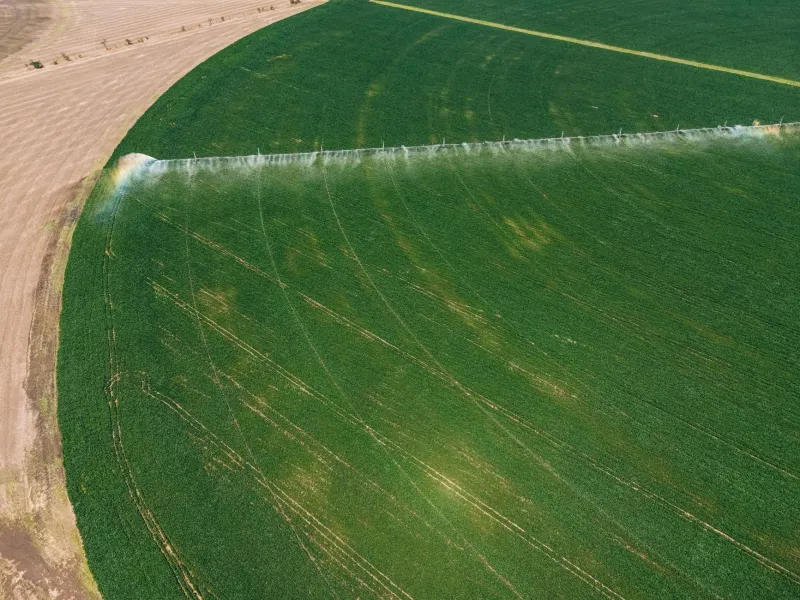
Drip irrigation is another game-changer that's still underutilized at scale. Rather than flood-irrigating fields or using overhead sprinklers that lose significant water to evaporation, drip systems deliver water directly to plant roots. Farms making the switch often see water savings of 30 to 50 percent for the same yield.
Jordan Settlemire, who runs a diversified vegetable operation in Colorado's Front Range, has incorporated both approaches on his 80-acre farm. "When I started building organic matter in my soil, I noticed I was irrigating less and less each season," he told us. "Last summer, during a stretch where my conventional neighbors were running their pivots constantly, I went two weeks without irrigating some fields. The soil just held it."
Water harvesting — capturing rainwater and snowmelt in ponds, swales, and earthworks — is another practice gaining traction among smaller farms, particularly in the Southwest. It's an ancient technique being rediscovered by farmers who've watched their well depths creep downward year after year.
What You Can Actually Do With This Information
It's easy to feel helpless in the face of aquifer depletion maps and satellite data. But your food choices do connect to this system in real ways.
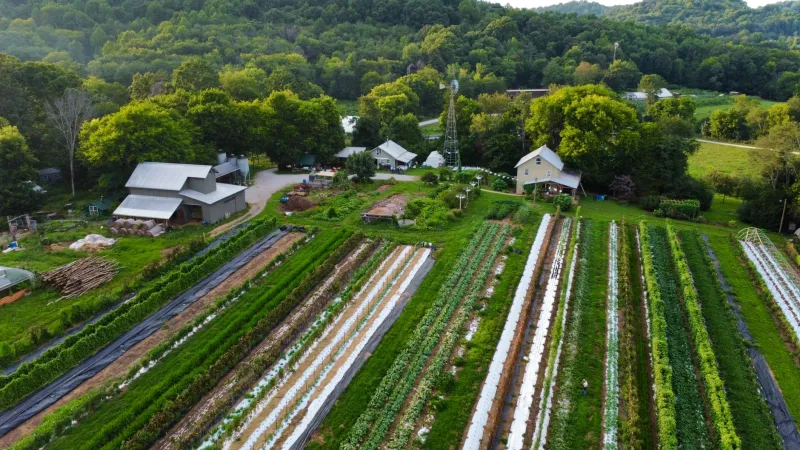
Buying from local and regional farms — especially those using regenerative or organic practices — tends to mean supporting operations that are more water-conscious by necessity. Smaller farms often can't afford the massive center-pivot irrigation systems that industrial operations run, so they've had to get smarter about water. Many of them are growing varieties better suited to their climate, managing soil health to maximize moisture retention, and rotating crops in ways that reduce overall water demand.
Asking questions at your farmers market matters too. Where does your water come from? Do you irrigate? How has your water use changed over the years? Farmers who are paying attention to these things will have answers — and they'll appreciate that you asked.
And if you're reducing your consumption of the most water-intensive foods — feedlot beef, almonds, and other high-demand crops grown in arid regions — that's a real and meaningful shift, even if it's incremental.
The Clock Underground
The water beneath America's farmland took millennia to accumulate. We've been drawing it down for 70 years and, in some places, we're already approaching the bottom. That's not a metaphor. That's geology.
The farmers who are figuring out how to grow food without mining the future are doing something genuinely radical — and genuinely necessary. They're proving that it's possible to feed people without treating water like it's infinite.
The question is whether the rest of the food system catches up before the wells run dry.