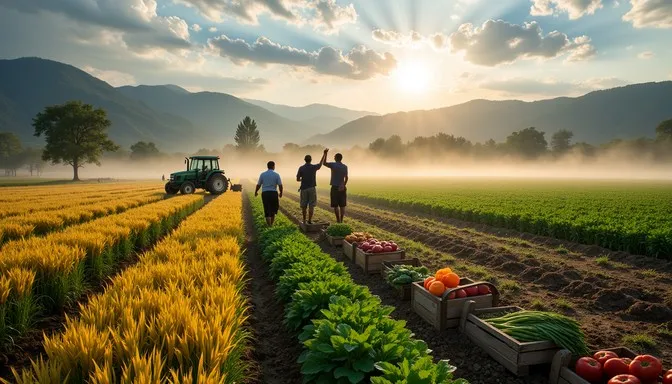
Some Farms Are Flourishing. Others Are Quietly Dying. Here's What's Actually Making the Difference.
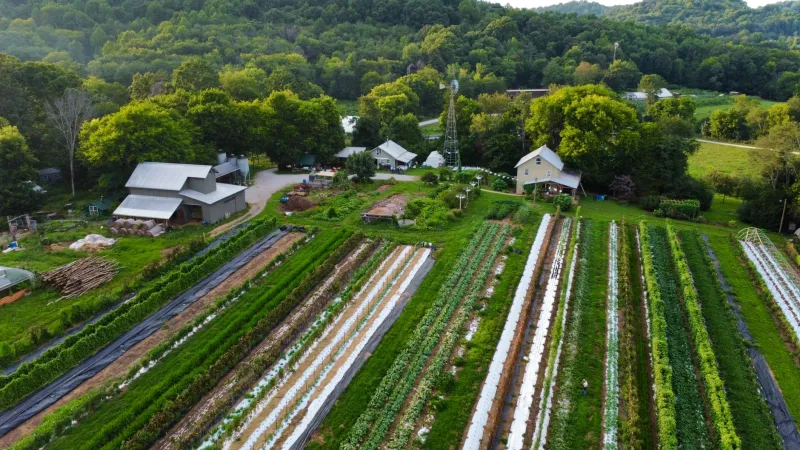
Drive through almost any rural county in America right now and you'll see it — the contrast that doesn't quite make sense at first glance. One farm has a packed Saturday stand at the local market, a CSA waitlist, and cover crops rolling green across every fallow field. Half a mile down the road, a weathered "For Sale" sign is leaning against a fence post that's seen better days.
Same region. Same growing season. Completely different outcomes.
This isn't a coincidence, and it's not just about who works harder. The farms that are making it through this particular stretch of agricultural history — rising input costs, climate volatility, consolidating supply chains — are doing something structurally different. And the ones quietly disappearing often had every good intention but missed a few critical pieces of the puzzle.
Let's talk about what's actually going on.
The Resilience Equation Isn't Just About Soil
Regeneration gets talked about a lot in the context of soil health — and for good reason. Farms that have invested in cover cropping, reduced tillage, and composting programs genuinely do see better water retention, lower input dependency, and more stable yields over time. That's real, and it matters.
But soil health alone won't save a farm that can't make payroll in October.
The farms building long-term resilience are doing it on two parallel tracks: ecological and economic. When those two tracks fall out of alignment — when a grower is doing everything right in the field but selling everything through a single wholesale contract that can be dropped with 30 days' notice — the whole operation becomes fragile in ways that no amount of healthy mycorrhizal networks can fix.
Take Clover Ridge Farm in central Vermont, a 90-acre operation that's been transitioning toward regenerative practices for the past seven years. Head farmer Maya Sorenson will tell you that the shift away from synthetic fertilizers was the easier part. "We knew how to grow differently," she says. "Learning how to sell differently took us three more years."
Clover Ridge now runs a 200-member CSA, supplies two local restaurants directly, and hosts farm dinners twice a month from June through September. None of those revenue streams existed five years ago. Together, they've insulated the farm from the price volatility that's crushing similar operations that still depend on wholesale produce buyers.
Scale Isn't the Advantage You Think It Is
There's a persistent assumption in American agriculture that bigger means safer. More acreage, more output, more margin for error. But the farms struggling hardest right now often aren't the small ones — they're the mid-size operations that scaled up before they built the customer relationships to support that growth.
Briarwood Family Farm in western North Carolina expanded from 40 to 140 acres between 2018 and 2021, riding a wave of pandemic-era demand for local food. When that demand softened and input costs spiked, they found themselves with significantly higher overhead and a customer base that hadn't kept pace with their production capacity.
"We grew the land before we grew the community," says co-owner Derek Huang. "And that's a hard thing to walk back."
Briarwood is still operating, but they've had to make painful decisions — leasing out acreage, reducing staff, and rebuilding their direct-to-consumer relationships from a smaller base. They're doing it, but it's a cautionary example of how regenerative practices in the field don't automatically translate to regenerative economics.
Compare that to Sundog Acres, a 22-acre vegetable farm in the Willamette Valley of Oregon that has never had any interest in getting bigger. Owners Priya and Tom Nakashima have kept their operation deliberately small, maxed out at 120 CSA shares, and spent years cultivating relationships with a food co-op, a farm-to-school program, and a local hospital's food service department.
Their diversified revenue base means no single buyer controls their fate. Their small footprint means lower fixed costs. And their deep community integration means that when things get hard — a late frost, a poor harvest season — their customers show up for them in ways that a wholesale contract never would.
The Community Piece Is the One Most Farms Underestimate
Here's something that doesn't get said enough: the most resilient farms in America right now are functioning more like community institutions than traditional agricultural businesses.
That's not just warm and fuzzy language. It has real structural implications. A farm that has embedded itself in its local food community — through education programs, U-pick events, partnerships with schools, CSA models that build genuine relationships with members — has created a kind of social capital that acts as a buffer during hard times.
When Clover Ridge had a devastating late-season flood two years ago that wiped out a significant portion of their fall crop, their CSA members voluntarily reduced their shares for the remainder of the season rather than demand refunds. Several organized a work party to help with cleanup. One member, a contractor, donated labor to repair a damaged greenhouse.
That kind of response doesn't happen with an anonymous wholesale buyer. It happens when people feel genuinely connected to where their food comes from.
Sundog's Priya Nakashima puts it plainly: "Our CSA members aren't customers. They're co-investors in our farm's future. They feel that way because we've worked hard to make them feel that way."
Where Even the Good Farms Are Vulnerable
It would be easy to end this piece on a triumphant note — resilient farms winning, unsustainable ones losing, justice served. But the reality is messier.
Even the farms doing everything right are facing vulnerabilities that community relationships and healthy soil can't fully address. Land access and land cost remain the most acute crisis in sustainable agriculture. A farm like Sundog Acres can build a thriving 22-acre operation, but if their lease isn't renewed or their landlord sells to a developer, that entire ecosystem collapses. Land ownership, or at the very least long-term secure tenure, is a prerequisite for genuine resilience — and it's increasingly out of reach for a new generation of farmers.
There's also the question of farmer health and succession. Many of the most successful sustainable farms in the country are run by people in their 50s and 60s who built these operations over decades. Without intentional succession planning — and without younger farmers who can afford to enter the profession — even the most thriving farm is one health crisis away from disappearing.
And then there's climate. Farms that have invested in soil health are genuinely better positioned to handle weather volatility. But "better positioned" isn't the same as "protected." The intensity of what's coming — the 100-year floods arriving every five years, the heat domes, the shifting frost dates — will test even the most ecologically sophisticated operations.
What You Can Do Right Now
If you've been reading this and feeling the weight of it, good. This is a moment that calls for more than passive appreciation of local food.
Join a CSA and pay for the full season upfront — that cash flow matters enormously to small farms. Ask your farmers market vendors whether they own or lease their land. Support organizations like the American Farmland Trust and your state's farmland preservation programs. If you live in a state with a beginning farmer tax credit, find out about it and tell someone who needs to know.
The farms that are going to feed your community twenty years from now are making decisions today. So are the communities around them. The gap between the farms that survive and the ones that don't is real — but it's not fixed. It's being written right now, and some of it is being written by you.