The Compost Bag Has a Shadow: What Rides Along With Your Food Scraps
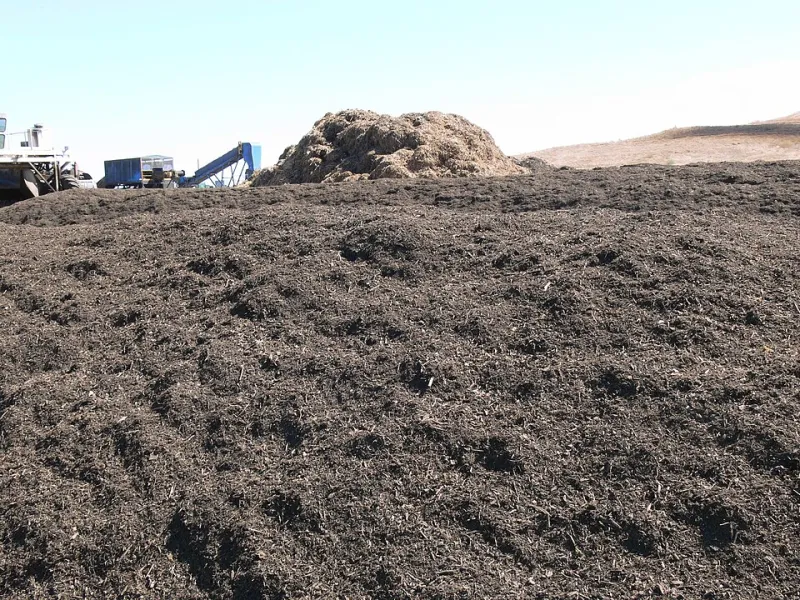
Photo: Ckgurney, CC BY-SA 3.0, via Wikimedia Commons
On a bright Saturday in October, a shopper in Ann Arbor, Michigan, drops a paper bag of coffee grounds and squash peels into a food-scrap bin. Six weeks later, some version of that material may be spread on a farm bed outside town. That is the promise of community composting: waste becomes fertility, and the loop closes. But there is a catch that rarely makes the bin signage. The same bag can carry per- and polyfluoroalkyl substances, the family of synthetic chemicals known as PFAS, into the compost that growers use to build soil.
PFAS are called forever chemicals for a reason. They do not break down easily in the environment, and some have been linked to health problems including liver damage, thyroid disease, and certain cancers. They show up in grease-resistant food wrappers, microwave popcorn bags, compostable fiber bowls, pizza boxes, and water-resistant clothing. They also appear in biosolids, the treated sewage sludge that some composters and farms use as a cheap source of organic matter. When those materials enter a compost pile, the chemicals do not politely disappear. They concentrate.
From Curb to Compost to Field
The journey is mundane, which is what makes it easy to ignore. A household separates food scraps. A hauler picks them up. A municipal or commercial facility grinds, turns, and heats the material until it becomes dark, crumbly compost. A farmer buys a truckload and spreads it on a vegetable bed. Each step is designed to recycle nutrients. None of those steps is designed to remove PFAS.
Composters are not villains here. Many are small operations trying to do the right thing with limited budgets. But they are caught in a supply chain they cannot fully control. A compostable bowl that meets a marketing standard may still contain PFAS in its grease-resistant lining. A food-scrap stream from a restaurant may include wrappers that were never meant to be composted. A facility that accepts biosolids may be bringing in a feedstock with its own contamination profile. Once those inputs are mixed, the resulting compost is only as clean as its dirtiest ingredient.
The Testing Gap
Here is the uncomfortable part: testing is voluntary and inconsistent. There is no single national PFAS limit for compost sold in the United States. Some states have adopted their own screening levels or testing requirements. Others have nothing specific on the books. A bag of compost may carry a seal, a compostability logo, or a cheerful claim about being natural, but none of those claims guarantee that the product has been tested for PFAS.
Even when testing happens, the details matter. Which PFAS compounds were tested? How many? What laboratory method was used? Was the sample taken from the finished product or from a single input? A result that says not detected can mean many things if the test only looked for a handful of chemicals. The PFAS family is large, and the science around acceptable levels is still moving.
Farmers who sell at farmers markets and run CSAs are often the most exposed to this problem and the least equipped to solve it. They want to build soil health. They want to reduce synthetic inputs. Compost is one of their best tools. But a small grower cannot easily afford a full PFAS panel for every load, and a bad result can threaten the farm's reputation even when the contamination came from packaging the farmer never handled.
What a Grower Can Do
Some farms are asking sharper questions of their suppliers. Where does the feedstock come from? Does the compost include biosolids? Are food-service packaging and compostable utensils accepted? Has the finished product been tested for PFAS, and can the farm see the lab report? What were the detection limits? How often is testing repeated?
Those questions are not paranoid. They are the same kind of questions a restaurant asks about produce suppliers or a retailer asks about organic certification. Transparency is the first tool in a system that has too few rules.
Consumers have a role too. If you buy compost for a garden or a community plot, ask the same questions. If your municipality runs a food-scrap program, show up at the meeting and ask whether compostable packaging is screened for PFAS. If a farm you support uses compost, ask where it comes from. The goal is not to shame composters or abandon composting. The goal is to make the loop honest.
Composting is still one of the most sensible things a food system can do. It keeps organic matter out of landfills, returns nutrients to soil, and supports farms that are trying to grow food with fewer chemical inputs. But a loop is only as strong as its weakest link. Right now, the weakest link may be invisible, riding along in a bag of food scraps and settling into the soil without anyone asking what came with it.