Good Intentions, Dirty Water: The Fertilizer Problem Hiding in Plain Sight on Sustainable Farms
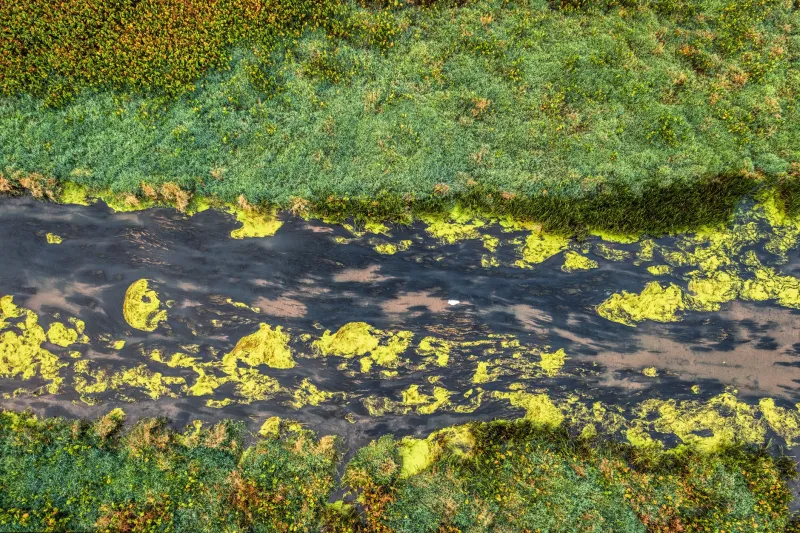
There's a particular kind of comfort that comes with buying food from a farm that describes itself as sustainable. You picture healthy soil, clean streams running along the property line, and a farmer who cares deeply about the land. That picture isn't wrong, exactly. But it's incomplete — and the part that's missing is quietly fueling one of the most significant water quality crises in the country.
Every summer, a massive stretch of the Gulf of Mexico — sometimes larger than the entire state of New Jersey — becomes nearly incapable of supporting marine life. Scientists call it a hypoxic zone. Most people call it a dead zone. The primary culprit isn't a mystery: it's nitrogen and phosphorus washing off farmland, traveling down rivers and tributaries, and eventually pouring into the Gulf through the Mississippi River system. And while industrial agriculture deserves the lion's share of blame, the uncomfortable reality is that some farms flying the sustainable flag are contributing to that same problem.
The Organic Input Loophole Nobody Talks About
Here's the thing about certified organic fertilizers: they're still fertilizers. Blood meal, fish emulsion, composted manure, feather meal — all of these are approved for organic use, and all of them deliver nitrogen to the soil. When applied thoughtfully, matched carefully to what crops actually need and timed to when plants can absorb them, they work beautifully. When over-applied — which happens more often than the industry likes to admit — the excess nitrogen doesn't just sit politely in the ground. It leaches into groundwater, runs off into streams, and eventually makes its way into larger waterways.
The certification system, for all its genuine value, doesn't directly regulate how much nutrient input a farm applies. It regulates what kind. That distinction matters enormously. A farm can use entirely approved organic inputs and still over-fertilize its fields by a wide margin, sending a slow, steady stream of excess nutrients into the watershed season after season.
This isn't a reason to abandon organic certification — it's a reason to understand what it does and doesn't cover.
Why Even Well-Meaning Farmers Overshoot
Talk to farmers who've wrestled with this issue and you'll hear a consistent theme: nutrient management is genuinely hard. Soil composition varies across a single field. Weather patterns change how quickly plants take up nutrients. A cold, wet spring can delay uptake significantly, leaving applied nutrients vulnerable to runoff before crops even get started. Organic matter breaks down at different rates depending on temperature and microbial activity.
There's also a psychological element. After a difficult growing season, it's tempting to apply a little extra — just to make sure. And because organic inputs break down more slowly than synthetic fertilizers, the timing of that release is harder to predict. Farmers working with tight margins and unpredictable weather are making judgment calls under pressure, and sometimes those calls result in more nutrients in the soil than the plants can use.
None of this makes over-fertilization acceptable. But it does make it understandable — and it points toward solutions that are practical rather than just punitive.
What Regenerative Nutrient Management Actually Looks Like
The farms that are genuinely getting this right aren't just swapping synthetic inputs for organic ones. They're rethinking the entire relationship between soil, nutrients, and water from the ground up.
Soil testing is the foundation. Not a once-a-year general assessment, but targeted, field-specific testing that tells a farmer exactly what's present, what's missing, and what the crop rotation ahead will actually demand. Farms like those participating in programs through the Rodale Institute or the Savanna Institute are using this kind of data-driven approach to apply only what's needed, when it's needed, where it's needed.
Cover cropping plays a critical role too. Nitrogen-fixing cover crops like clover, vetch, and field peas can build soil nitrogen naturally between growing seasons, reducing the need for external inputs altogether. Equally important, cover crops keep living roots in the ground during periods when cash crops aren't growing — and living roots are remarkably effective at holding nutrients in place rather than letting them wash away.
Buffer strips along waterways — bands of native grasses, wildflowers, or shrubs between fields and streams — act as a physical filter, capturing runoff before it reaches open water. They're one of the most cost-effective conservation tools available, and yet they remain underutilized on many farms, including some that market themselves aggressively as environmentally responsible.
The Consumer's Blind Spot
As eaters, we've gotten pretty good at reading labels. We look for organic, non-GMO, pasture-raised, fair trade. What we haven't developed — because the information largely isn't available to us — is a way to evaluate how a farm manages its relationship with local waterways.
That's not entirely our fault. The food system doesn't make this easy. Certification bodies don't require nutrient management plans as a condition of organic status. Farm websites don't typically publish their soil test results or their annual application records. The story we're sold is usually about what goes in — heritage seeds, no synthetic chemicals, happy animals — not about what flows out.
Asking questions at the farmers market isn't a perfect solution, but it's a start. Does this farm use cover crops? Do they have buffer strips along their creek? Have they done a nutrient management plan with their county extension office? A farmer who's genuinely thinking about these things will usually be glad someone asked.
Feeding the Soil Without Feeding the Problem
The goal of truly regenerative nutrient management isn't to starve the soil. It's to build the kind of living, biologically active soil system that feeds itself — where mycorrhizal fungi, bacteria, earthworms, and organic matter cycle nutrients in ways that keep them available to plants and out of waterways.
That kind of system takes years to develop. It requires patience, observation, and a willingness to measure success not just in yield per acre but in the health of the creek running along the back fence. It asks farmers to think beyond their property line and consider themselves stewards of a watershed, not just a field.
Some farms are already doing exactly that. They're not always the loudest voices in the sustainable food space, and they may not have the shiniest marketing. But they're the ones whose good intentions actually match their environmental footprint — and that's a distinction worth seeking out.
Because at the end of the day, food grown with care for the soil and the water downstream isn't just better for the planet. It's the only version of sustainable that actually holds up under scrutiny.